Purpose
The NyuWa Global 10K T2T Variant Database (NyuWaT2T) is designed to collect single nucleotide polymorphisms (SNPs) and insertions or deletions (InDels) as well as tandem repeat variations (TRVs), mobile element variations (MEVs) and structure variations (SV) in global populations from high quality whole genome sequencing data, and to comprehensively annotate the variants on allele frequency in our Chinese dataset and external datasets (including 1KGP,HGDP,SGDP).
Data Statistics
As its current version, NyuWa variants database archives 211 million (M) SNPs/InDels, 2.02M TRVs, 101k MEs and 251k SVs based on high depth (median 31.7X) WGS of 10,457 individuals from global populations in 1KGP, HGDP, SGDP and our own Chinese samples.
Dataset overview
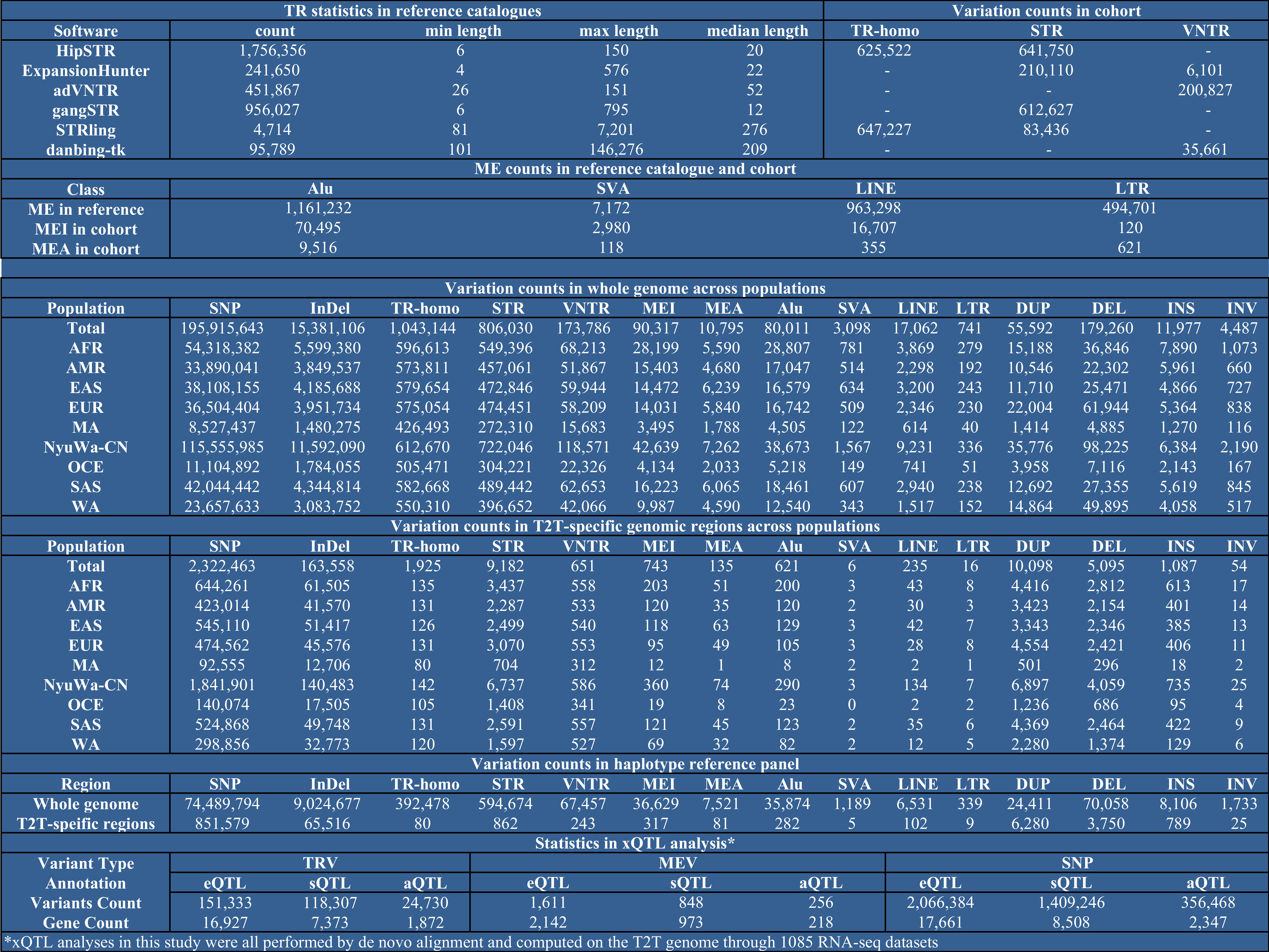
The overview of our dataset is as follows: the table includes the scale of the reference catalogues we used and the number of variants found in each population across various types.
Variants Introduction
SNP
Single-nucleotide polymorphism, refers to a change in a single nucleotide that occurs at a particular spot in the genome. SNPs are the most common type of genetic variation. They are widely present in the human genome and can significantly impact gene function and regulation, which is crucial for understanding traits, diseases, and individual responses to treatments. SNPs serve as valuable markers in genetic research, allowing scientists to study inheritance patterns, trace ancestry, and develop personalized medical approaches.
InDel
Small insertion and deletion, refers to insertion or deletion of DNA bases which affects less 50 bases in an organism's genome. InDels are a significant source of genetic variation, as they can lead to changes in gene function, regulation, and protein coding. There are large numbers of InDels in genome, and they can be used to study genetic diversity, population genetics, and molecular breeding. InDels can occur throughout the genome, making them potentially impactful on gene expression and phenotype. They can also be used as molecular markers for genetic linkage mapping and the identification of genetic variations associated with specific traits or diseases
TR-homo
Homopolymer, refers to a tract of repetitive DNA is characterized by the tandem repetition of specific DNA motifs which are exactly one base pair (1bp) in length. They can contribute to genetic diversity and have functional implications. For instance, they can create challenges during DNA replication and repair processes, as the repeated single base pairs can lead to slippage and mismatches. This can result in mutations, which may have consequences for gene function and regulation.
STR
Short tandem repeat, refers to a tract of repetitive DNA is characterized by the tandem repetition of specific DNA motifs, which can range from two to six base pairs(2-6bp) in length. STRs are scattered throughout the genome and can be found in both coding and non-coding regions. The high variability in repeat numbers within STRs makes them valuable for genetic analysis, such as in paternity testing, population studies, and forensics for individual identification. They can also influence gene expression and function if located within or near genes, and are subject to evolutionary pressures, leading to functional consequences in some cases. STRs represent a rich source of genetic variation that aids in understanding genetic diversity and evolution.
VNTR
Variable number tandem repeat, refers to a tract of repetitive DNA is characterized by the tandem repetition of specific DNA motifs which are longer than seven base pairs(> 7bp). The number of repeats can vary significantly between individuals, leading to high polymorphism and making VNTRs valuable for genetic studies, such as in forensics, population genetics, and disease association studies.VNTRs can influence gene expression and function if they are located within or near genes. The polymorphic nature of VNTRs, due to the different numbers of repeat units among individuals.
SINE
Short interspersed nuclear element, refers to a class of non-autonomous, non-coding transposable element that are approximately 100 to 700 base pairs in length. They are a type of retrotransposon, which means they amplify themselves throughout eukaryotic genomes using RNA intermediates. It includes two primary subfamilies of particular interest in humans: Alu and SINE-VNTR-Alu (SVA).
Alu elements are the most well-known SINEs in humans and are derived from the 7SL RNA gene. They are approximately 300 base pairs long and are found in over a million copies throughout the human genome.
SVA (SINE-VNTR-Alu) elements are a type of transposable element found in the human genome. They are relatively recent additions, specific to hominoids, and are composed of several distinct regions: a 5′ region with a hexamer repeat (CCCTCT)n, an Alu-like sequence, a variable number tandem repeats (VNTR), a SINE-R domain, a poly-A tail at the 3′ end.SVAs are larger than typical SINEs, ranging from 0.7 to 4 kb in length. They are involved in shaping the human genome's structure and can influence gene expression. Despite being considered genetic parasites, SVAs have been integrated into human biology and contribute to genetic diversity.
LINE
Long interspersed nuclear elements, refers to a class of non-coding, autonomously replicating transposable element found in the genomes of mammals. LINEs are large DNA sequences that can replicate themselves and insert copies into new locations within the genome. They are significant components of the human genome, accounting for about 17% of our genetic material. LINEs have the ability to "jump" around, which contributes to genetic diversity and can sometimes affect gene function when they insert near or within genes. Despite their potential to cause genetic disruptions, LINEs have been integrated into the regulatory and metabolic pathways of eukaryotes, contributing to genetic variability and playing significant roles in gene expression regulation and the creation of RNA genes. They also influence chromatin reorganization and the regulation of genomic architecture. LINEs are a testament to the dynamic nature of genomes and their role in evolution and development.
LTR
Long terminal repeat,refers to a type of retrotransposon found in eukaryotic genomes, characterized by the presence of long, repetitive sequences at both ends. An LTR element includes a gag gene, which encodes structural proteins, and a pol gene, which encodes enzymes for replication. These elements replicate through an RNA intermediate and can influence gene expression and regulation. Although they can cause genetic disruptions, LTRs also contribute to genetic diversity and play a role in the evolution of genomes.
DUP
Duplication, refers to a kind of structural variation(SV), is a type of genetic alteration where a segment of DNA, greater than 50 base pairs (bp) in length, is copied and inserted elsewhere in the genome. DUPs can lead to an increase in gene copy number, which can have various effects on gene expression and function. They are a subset of copy number variations (CNVs). DUPs are significant because they can contribute to genetic diversity and are associated with certain diseases and traits. They can range in size from a few base pairs to large segments of DNA and are often detected through genomic sequencing and analysis techniques.
DEL
Deletion, refers to a kind of structural variation(SV), is a type of genetic alteration where a segment of DNA greater than 50 base pairs in length is removed from the genome. Deletions can range from small, affecting a few base pairs, to large, involving entire genes or more. They can lead to a loss of genetic information, which can have various effects on an organism, including the disruption of gene function, regulation, and the potential to cause diseases or developmental disorders. DELs are an important aspect of genetic diversity and can play a role in evolution by removing sequences that may no longer be beneficial or by creating new genetic combinations.
INS
Insertion, refers to a type of structural variation(SV) where a segment of DNA is added to the genome, typically larger than 50 base pairs. Insertions can be caused by various mechanisms, including the movement of transposable elements, viral integration, or errors during DNA replication. can significantly impact gene function and regulation. Insertions can lead to several genetic consequences, such as disrupting the coding sequence of a gene, creating new splice variants, or altering the expression levels of nearby genes. They can also introduce new genetic material into the genome, which may contribute to genetic diversity and evolution.
INV
Invertion, refers to a kind of structural variation(SV) in the genome where a segment of DNA is reversed in orientation. This means that a portion of the chromosome is flipped 180 degrees, causing the genes within that segment to be in the opposite order than they were previously. Inversions can range in size from small, affecting a few base pairs, to large, involving entire chromosomes. They can occur spontaneously or be induced by external factors and can have various effects on the organism, including the disruption of gene function or regulation. Inversions are significant in genomic studies as they can contribute to genetic diversity and are associated with certain diseases and traits.